♥আল্লাহ সর্বশক্তিমান । ♥


This is default featured slide 1 title

Go to Blogger edit html and find these sentences.Now replace these sentences with your own descriptions.

This is default featured slide 2 title

Go to Blogger edit html and find these sentences.Now replace these sentences with your own descriptions.

This is default featured slide 3 title

Go to Blogger edit html and find these sentences.Now replace these sentences with your own descriptions.

This is default featured slide 4 title

Go to Blogger edit html and find these sentences.Now replace these sentences with your own descriptions.

This is default featured slide 5 title

Go to Blogger edit html and find these sentences.Now replace these sentences with your own descriptions.

Showing posts with label seo google. Show all posts

Tuesday, May 16, 2017

The True Power of Inbound Marketing with SEO

The True Power of Inbound Marketing with SEO

Why should you invest time, effort, and resources on SEO? When looking at the broad picture of search engine usage, fascinating data is available from several studies. We've extracted those that are recent, relevant, and valuable, not only for understanding how users search, but to help present a compelling argument about the power of SEO.
A Broad Picture

Google leads the way in an October 2011 study by comScore:

  • Google led the U.S. core search market in April with 65.4 percent of the searches conducted, followed by Yahoo! with 17.2 percent, and Microsoft with 13.4 percent. (Microsoft powers Yahoo Search. In the real world, most webmasters see a much higher percentage of their traffic from Google than these numbers suggest.)
  • Americans alone conducted a staggering 20.3 billion searches in one month. Google accounted for 13.4 billion searches, followed by Yahoo! (3.3 billion), Microsoft (2.7 billion), Ask Network (518 million), and AOL LLC (277 million).
  • Total search powered by Google properties equaled 67.7 percent of all search queries, followed by Bing which powered 26.7 percent of all search.
  • view online

Billions spent on online marketing from an August 2011 Forrester report:

  • Online marketing costs will approach $77 billion in 2016.
  • This amount will represent 26% of all advertising budgets combined.
  • view online
  • view

Search is the new Yellow Pages from a Burke 2011 report:

  • 76% of respondents used search engines to find local business information vs. 24% who turned to print yellow pages.
  • 67% had used search engines in the past 30 days to find local information, and 23% responded that they had used online social networks as a local media source.
    view online


An August 2011 Pew Internet study revealed:

  • The percentage of Internet users who use search engines on a typical day has been steadily rising from about one-third of all users in 2002, to a new high of 59% of all adult Internet users.
  • With this increase, the number of those using a search engine on a typical day is pulling ever closer to the 61 percent of Internet users who use e-mail, arguably the Internet's all-time killer app, on a typical day.
    view online

StatCounter Global Stats reports the top 5 search engines sending traffic worldwide:

  • Google sends 90.62% of traffic.
  • Yahoo! sends 3.78% of traffic.
  • Bing sends 3.72% of traffic.
  • Ask Jeeves sends .36% of traffic.
  • Baidu sends .35% of traffic.
    view online

A 2011 study by Slingshot SEO reveals click-through rates for top rankings:

  • A #1 position in Google's search results receives 18.2% of all click-through traffic.
  • The second position receives 10.1%, the third 7.2%, the fourth 4.8%, and all others under 2%.
  • A #1 position in Bing's search results averages a 9.66% click-through rate.
  • The total average click-through rate for first ten results was 52.32% for Google and 26.32% for Bing.
  • view online

How People Interact With Search Engines

How People Interact with Search Engines
One of the most important elements to building an online marketing strategy around SEO is empathy for your audience. Once you grasp what your target market is looking for, you can more effectively reach and keep those users.
Robot Evolution
We like to say, "Build for users, not for search engines." There are three types of search queries people generally make:
  • "Do" Transactional Queries: I want to do something, such as buy a plane ticket or listen to a song.
  • "Know" Informational Queries: I need information, such as the name of a band or the best restaurant in New York City.
  • "Go" Navigation Queries: I want to go to a particular place on the Internet, such as Facebook or the homepage of the NFL.
When visitors type a query into a search box and land on your site, will they be satisfied with what they find? This is the primary question that search engines try to answer billions of times each day. The search engines' primary responsibility is to serve relevant results to their users. So ask yourself what your target customers are looking for and make sure your site delivers it to them.
It all starts with words typed into a small box.


How people use search engines has evolved over the years, but the primary principles of conducting a search remain largely unchanged. Most search processes go something like this:
  1. Experience the need for an answer, solution, or piece of information.
  1. Formulate that need in a string of words and phrases, also known as “the query.”
  1. Enter the query into a search engine.
  1. Browse through the results for a match.
  1. Click on a result.
  1. Scan for a solution, or a link to that solution.
  1. If unsatisfied, return to the search results and browse for another link or ...
  1. Perform a new search with refinements to the query.

Sunday, May 14, 2017

An Example Test We Performed

An Example Test We Performed

In our test, we started with the hypothesis that a link earlier (higher up) on a page carries more weight than a link lower down on the page. We tested this by creating a nonsense domain with a home page with links to three remote pages that all have the same nonsense word appearing exactly once on the page. After the search engines crawled the pages, we found that the page with the earliest link on the home page ranked first.

This process is useful, but is not alone in helping to educate search marketers.

In addition to this kind of testing, search marketers can also glean competitive intelligence about how the search engines work through patent applications made by the major engines to the United States Patent Office. Perhaps the most famous among these is the system that gave rise to Google in the Stanford dormitories during the late 1990s, PageRank, documented as Patent #6285999: "Method for node ranking in a linked database." The original paper on the subject – Anatomy of a Large-Scale Hypertextual Web Search Engine – has also been the subject of considerable study. But don't worry; you don't have to go back and take remedial calculus in order to practice SEO!
Through methods like patent analysis, experiments, and live testing, search marketers as a community have come to understand many of the basic operations of search engines and the critical components of creating websites and pages that earn high rankings and significant traffic.

How Search Engines Operate

How Search Engines Operate

Search engines have two major functions: crawling and building an index, and providing search users with a ranked list of the websites they've determined are the most relevant.
Crawling and Indexing

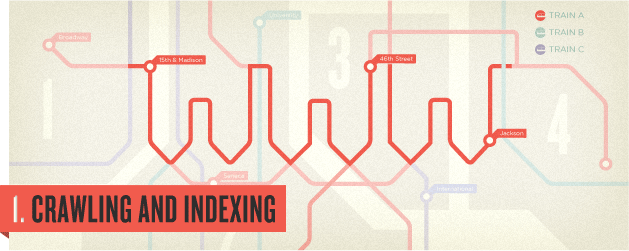
Imagine the World Wide Web as a network of stops in a big city subway system.

Each stop is a unique document (usually a web page, but sometimes a PDF, JPG, or other file). The search engines need a way to “crawl” the entire city and find all the stops along the way, so they use the best path available—links.

  1. Crawling and Indexing
    Crawling and indexing the billions of documents, pages, files, news, videos, and media on the World Wide Web.
  2. Providing Answers
    Providing answers to user queries, most frequently through lists of relevant pages that they've retrieved and ranked for relevancy.

The link structure of the web serves to bind all of the pages together.

Links allow the search engines' automated robots, called "crawlers" or "spiders," to reach the many billions of interconnected documents on the web.
Once the engines find these pages, they decipher the code from them and store selected pieces in massive databases, to be recalled later when needed for a search query. To accomplish the monumental task of holding billions of pages that can be accessed in a fraction of a second, the search engine companies have constructed datacenters all over the world.
These monstrous storage facilities hold thousands of machines processing large quantities of information very quickly. When a person performs a search at any of the major engines, they demand results instantaneously; even a one- or two-second delay can cause dissatisfaction, so the engines work hard to provide answers as fast as possible.

Large Hard Drive
Providing Answers
Search engines are answer machines. When a person performs an online search, the search engine scours its corpus of billions of documents and does two things: first, it returns only those results that are relevant or useful to the searcher's query; second, it ranks those results according to the popularity of the websites serving the information. It is both relevance and popularity that the process of SEO is meant to influence.

How do search engines determine relevance and popularity?

To a search engine, relevance means more than finding a page with the right words. In the early days of the web, search engines didn’t go much further than this simplistic step, and search results were of limited value. Over the years, smart engineers have devised better ways to match results to searchers’ queries. Today, hundreds of factors influence relevance, and we’ll discuss the most important of these in this guide.
Search engines typically assume that the more popular a site, page, or document, the more valuable the information it contains must be. This assumption has proven fairly successful in terms of user satisfaction with search results.
Popularity and relevance aren’t determined manually. Instead, the engines employ mathematical equations (algorithms) to sort the wheat from the chaff (relevance), and then to rank the wheat in order of quality (popularity).
These algorithms often comprise hundreds of variables. In the search marketing field, we refer to them as “ranking factors.” Moz crafted a resource specifically on this subject: Search Engine Ranking Factors.

Keep ReadingSearch Engine Results
You can surmise that search engines believe that Ohio State is the most relevant and popular page for the query “Universities” while the page for Harvard is less relevant/popular.

How Do I Get Some Success Rolling In?

Or, "how search marketers succeed"

The complicated algorithms of search engines may seem impenetrable. Indeed, the engines themselves provide little insight into how to achieve better results or garner more traffic. What they do provide us about optimization and best practices is described below:
How Do I Get Success
Google

SEO INFORMATION FROM GOOGLE WEBMASTER GUIDELINES

Google recommends the following to get better rankings in their search engine:
  • Make pages primarily for users, not for search engines. Don't deceive your users or present different content to search engines than you display to users, a practice commonly referred to as "cloaking."
  • Make a site with a clear hierarchy and text links. Every page should be reachable from at least one static text link.
  • Create a useful, information-rich site, and write pages that clearly and accurately describe your content. Make sure that your <title> elements and ALT attributes are descriptive and accurate.
  • Use keywords to create descriptive, human-friendly URLs. Provide one version of a URL to reach a document, using 301 redirects or the rel="canonical" attribute to address duplicate content.
Bing

SEO INFORMATION FROM BING WEBMASTER GUIDELINES

Bing engineers at Microsoft recommend the following to get better rankings in their search engine:
  • Ensure a clean, keyword rich URL structure is in place.
  • Make sure content is not buried inside rich media (Adobe Flash Player, JavaScript, Ajax) and verify that rich media doesn't hide links from crawlers.
  • Create keyword-rich content and match keywords to what users are searching for. Produce fresh content regularly.
  • Don’t put the text that you want indexed inside images. For example, if you want your company name or address to be indexed, make sure it is not displayed inside a company logo.

Have No Fear, Fellow Search Marketer!

In addition to this freely-given advice, over the 15+ years that web search has existed, search marketers have found methods to extract information about how the search engines rank pages. SEOs and marketers use that data to help their sites and their clients achieve better positioning.
Surprisingly, the engines support many of these efforts, though the public visibility is frequently low. Conferences on search marketing, such as the Search Marketing Expo, Pubcon, Search Engine Strategies, Distilled, and Moz’s own MozCon attract engineers and representatives from all of the major engines. Search representatives also assist webmasters by occasionally participating online in blogs, forums, and groups.

Tip of the Iceberg
Time for an Experiment
There is perhaps no greater tool available to webmasters researching the activities of the engines than the freedom to use the search engines themselves to perform experiments, test hypotheses, and form opinions. It is through this iterative—sometimes painstaking—process that a considerable amount of knowledge about the functions of the engines has been gleaned. Some of the experiments we’ve tried go something like this:
  1. Register a new website with nonsense keywords (e.g., ishkabibbell.com).
  2. Create multiple pages on that website, all targeting a similarly ludicrous term (e.g., yoogewgally).
  3. Make the pages as close to identical as possible, then alter one variable at a time, experimenting with placement of text, formatting, use of keywords, link structures, etc.
  4. Point links at the domain from indexed, well-crawled pages on other domains.              
  1. Record the rankings of the pages in search engines.
  2. Now make small alterations to the pages and assess their impact on search results to determine what factors might push a result up or down against its peers.
  3. Record any results that appear to be effective, and re-test them on other domains or with other terms. If several tests consistently return the same results, chances are you’ve discovered a pattern that is used by the search engines.                                                                                                                                                                                                                                     Read more »

Saturday, May 13, 2017

New to SEO? Need to polish up your knowledge? The Beginner's Guide to SEO has been read over 3 million times and provides comprehensive information you need to get on the road to professional quality Search Engine Optimization, or SEO.

Beginner's Guide to SEO
New to SEO? Need to polish up your knowledge? The Beginner's Guide to SEO has been read over 3 million times and provides comprehensive information you need to get on the road to professional quality Search Engine Optimization, or SEO.
  1. CHAPTER 1      How Search                                                  Engines Operate
  2.  CHAPTER 2
  3. How People Interact With Search Engines
  4.  CHAPTER 3
  5. Why Search Engine Marketing is Necessary
  6.  CHAPTER 4
  7. The Basics of Search Engine Friendly Design & Development
  8.  CHAPTER 5
  9. Keyword Research
  1.   CHAPTER 6        How Usability,                                             Experience, &Content                                         Affect Rankings
  2.  CHAPTER 7
  3. Growing Popularity and Links
  4.  CHAPTER 8
  5. Search Engine's Tools for Webmasters Intro
  6.  CHAPTRE 9
  7. Myths & Misconceptions About Search Engines
  8.  CHAPTR 10
  9. Measuring and Tracking Success

What is Search Engine Optimization (SEO)?

SEO is a marketing discipline focused on growing visibility in organic (non-paid) search engine results. SEO encompasses both the technical and creative elements required to improve rankings, drive traffic, and increase awareness in search engines. There are many aspects to SEO, from the words on your page to the way other sites link to you on the web. Sometimes SEO is simply a matter of making sure your site is structured in a way that search engines understand.
SEO isn't just about building search engine-friendly websites. It's about making your site better for people too. At Moz we believe these principles go hand-in-hand.
This guide is designed to describe all areas of SEO—from finding the terms and phrases (keywords) that generate traffic to your website, to making your site friendly to search engines, to building links and marketing the unique value of your site. If you are confused about this stuff, you are not alone, and we're here to help.
Search Engine Market Share

Why does my website need SEO?

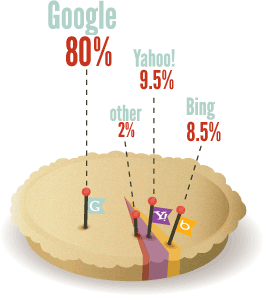
The majority of web traffic is driven by the major commercial search engines, Google, Bing, and Yahoo!. Although social media and other types of traffic can generate visits to your website, search engines are the primary method of navigation for most Internet users. This is true whether your site provides content, services, products, information, or just about anything else.
Search engines are unique in that they provide targeted traffic—people looking for what you offer. Search engines are the roadways that make this happen. If search engines cannot find your site, or add your content to their databases, you miss out on incredible opportunities to drive traffic to your site.
Search queries—the words that users type into the search box—carry extraordinary value. Experience has shown that search engine traffic can make (or break) an organization's success. Targeted traffic to a website can provide publicity, revenue, and exposure like no other channel of marketing. Investing in SEO can have an exceptional rate of return compared to other types of marketing and promotion.

Why can't the search engines figure out my site without SEO?

Search engines are smart, but they still need help. The major engines are always working to improve their technology to crawl the web more deeply and return better results to users. However, there is a limit to how search engines can operate. Whereas the right SEO can net you thousands of visitors and increased attention, the wrong moves can hide or bury your site deep in the search results where visibility is minimal.
In addition to making content available to search engines, SEO also helps boost rankings so that content will be placed where searchers will more readily find it. The Internet is becoming increasingly competitive, and those companies who perform SEO will have a decided advantage in visitors and customers.

Can I do SEO for myself?

The world of SEO is complex, but most people can easily understand the basics. Even a small amount of knowledge can make a big difference. Free SEO education is widely available on the web, including in guides like this. Combine this with a little practice and you are well on your way to becoming a guru.
Depending on your time commitment, your willingness to learn, and the complexity of your website(s), you may decide you need an expert to handle things for you. Firms that practice SEO can vary; some have a highly specialized focus, while others take a broader and more general approach.
In any case, it's good to have a firm grasp of the core concepts.

How much of this article do I need to read?

If you are serious about improving search traffic and are unfamiliar with SEO, we recommend reading this guide front-to-back. We've tried to make it as concise as possible and easy to understand. There's a printable PDF version for those who'd prefer, and dozens of linked-to resources on other sites and pages that are also worthy of your attention.

Each section of this guide is important to understanding the most effective practices of search engine optimization.

Let's Get You Started

In the wonderful world of SEO!

The Beginner's Guide to Search Engine Optimization (SEO) is an in-depth tutorial on how search engines work. This guide covers the fundamental strategies that make your websites search engine–friendly. Download your copy of the world's most-read guide on SEO!

Try out Moz Pro

Subscribe to Moz Pro free for 30 days. In addition to marketing analytics software, you’ll get to access dozens of SEO and inbound marketing resources.

Download PDFSearch Engine Traffic